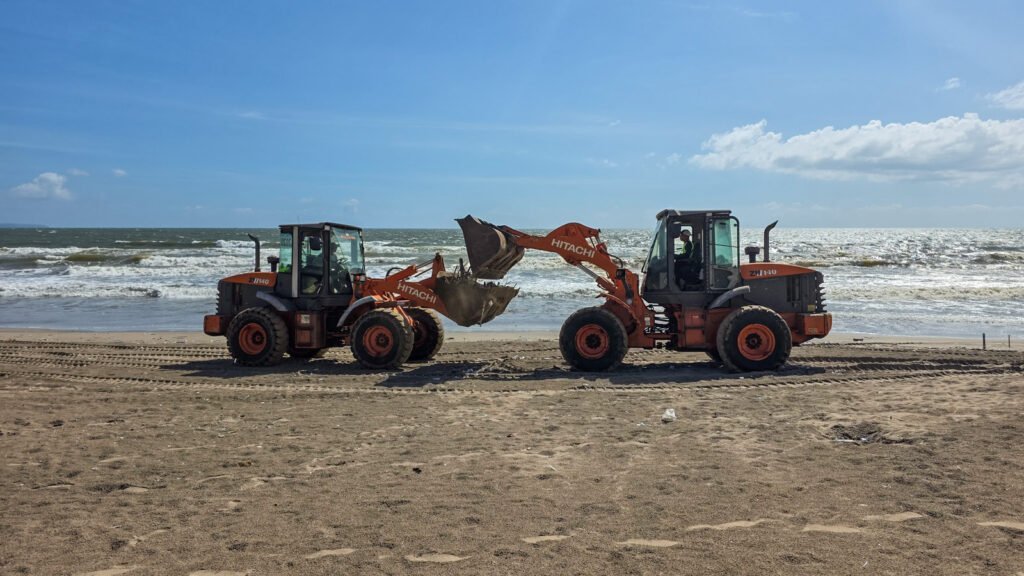
The machines arrived today.
Large tractors moving slowly across the sand, pushing piles of plastic together.
Yesterday the beach was covered in it, bottles, packaging, fragments carried in by the tide.
Behind the machines, a few workers followed with bags and gloves, collecting what the tractors couldn’t move.
Small pieces.
Bottle caps.
Thin fragments of bags.
Things too scattered or too light for the machines.
From a distance, the work looks effective.
The large piles disappear quickly once the machines begin pushing them across the sand.
But walking closer tells a different story.
Plastic still covers the beach in small pieces.
Half buried in the sand.
Caught in seaweed.
Spread thinly along the shoreline.
The machines remove the visible piles.
The rest becomes manual work.
Piece by piece.
Slow work.
And even that work sits inside a larger system.
The tide that carried the plastic here last night is still moving.
Ocean currents continue their routes across thousands of kilometers of water.
Tomorrow morning, the beach may look different again.
Watching the machines push the large piles across the sand, it’s hard not to think back to the earlier comparison between ocean currents and AI systems.
Large systems move things at scale.
Fast.
Efficiently.
But the smaller fragments, the edge cases, the unintended outputs, rarely disappear on their own.
They almost always end up downstream.
Where someone eventually has to pick them up.
One piece at a time.