Over the past few months, I’ve started noticing something I wasn’t expecting.
Not in technology.
In people.
The easier technology makes creation, the more people seem to value the act of creating.
At first, it seemed like coincidence.
Young people in Vietnam carrying dedicated Fujifilm cameras instead of relying on the smartphones already in their pockets.
More wired headphones.
Vinyl records continuing to attract new listeners.
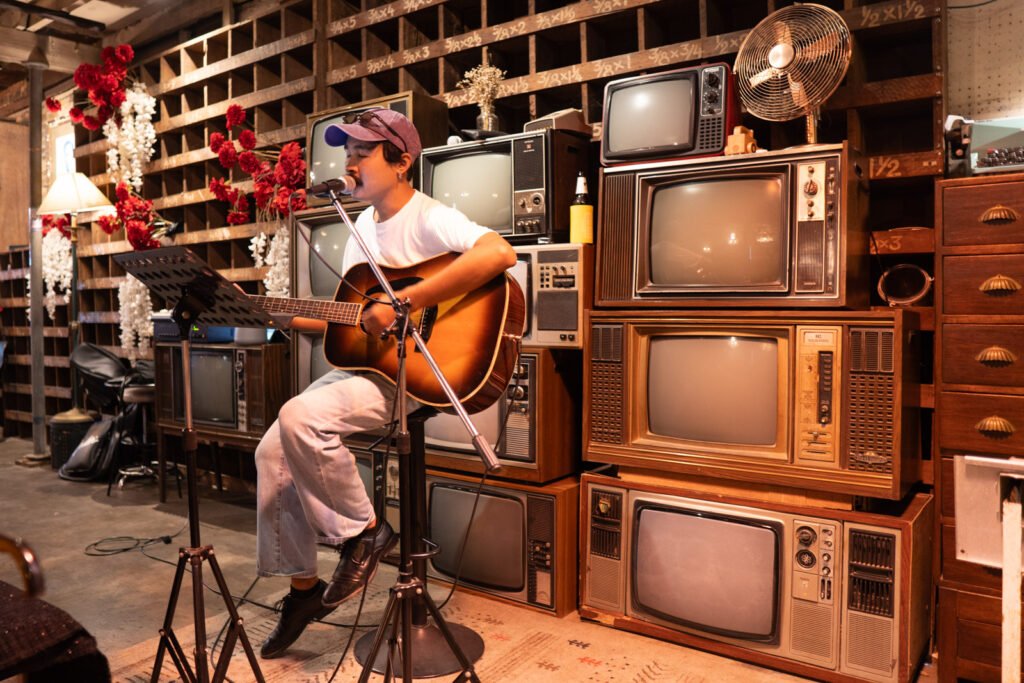
And one evening, I watched a man quietly playing an acoustic guitar in front of a stack of old television sets while people stopped to listen. In fact, he plays there every evening, and people still stop to listen.
Individually, none of these observations mean very much.
Together, they started to feel like a pattern.
We’ve spent decades removing friction from almost everything we do.
What once required kilos of electronic equipment, mechanical parts, cables, and dedicated devices can now fit into something that weighs less than 250 grams in your pocket.
We can photograph, write, record music, edit videos, and publish our work faster than at any other point in history.
And now AI is removing another layer of effort.
Yet everywhere I look, I keep seeing people willingly choosing tools that ask more of them.
That made me wonder if convenience is no longer the whole story.
More Than Nostalgia
The obvious explanation would be nostalgia.
But I don’t think that’s what I’m seeing.
Yes, some teenagers are fascinated by the colourful aesthetics of the eighties and nineties.
But I don’t think they’re the main driver here.
My own 16-year-old daughter had to stop and think when I told her that, before digital cameras, we couldn’t simply look at the photograph we had just taken. We had to finish the roll of film, send it away to be developed, and wait days before discovering whether we’d captured the moment at all.
She has grown up in a world where every photograph appears instantly on a screen.
This doesn’t feel like a return to the past.
It feels like a search for something else, a way to become more involved in the act of creating.
Technology has become remarkably good at removing effort.
Taking a photograph no longer requires much thought. If the first image isn’t right, you simply take another. Then another. AI can improve it afterwards.
Writing has become easier.
Editing has become easier.
Music production has become easier.
Soon, creating a realistic video may be little more than describing it in a prompt.
What we now call prompting isn’t entirely new either. We’ve been trying to tell computers what we want them to do for more than forty years.
None of this is a bad thing.
I use AI almost every day. Digital cameras have transformed photography. Streaming has given us access to almost every song ever recorded.
The technology is extraordinary.
But when almost everything becomes effortless, effort itself starts to feel valuable. Not because effort is the goal, but because it reveals the human behind the work.
Participation changes not only what we create, but how we experience creating it.
Slowing Down to Notice
I’ve noticed something similar in my own life.
A few months ago, I became much more interested in photography.
Not because I needed another camera.
Not because I wanted another hobby.
Because it changed how I experienced the places I was already visiting.
Instead of simply walking through a market and taking a quick shot here and there with my phone, I found myself slowing down.
Watching how the light moved through a street.
Waiting for someone to step into the frame.
Looking at ordinary moments that I would probably have walked past only weeks earlier.
The camera didn’t just record the experience.
It changed the experience.
It asked more of me.
More patience.
More attention.
More presence.
More reflection.
Ironically, the photographs became almost secondary.
The real value was that I had become more involved in the world around me.
The Human Signal
Technology will continue to improve.
AI will become better at writing.
Cameras will become smarter.
Music will become easier to produce.
Video will increasingly be generated instead of filmed.
I don’t see any of that as a bad thing.
Quite the opposite.
These technologies are opening up extraordinary possibilities.
But I also think they’re making something else more visible.
The moments where another human being clearly chose to be present.
To wait for the light instead of rushing the photograph.
To practise the guitar instead of pressing play.
To write because they had something to say, not simply because they could generate the words.
Perhaps that’s what I’ve really been noticing.
Not a return to old technology.
Not a rejection of AI.
But a growing appreciation for the human behind the work.
As technology removes more and more friction, humanity itself becomes easier to recognise.
And maybe that’s exactly what we’re searching for.